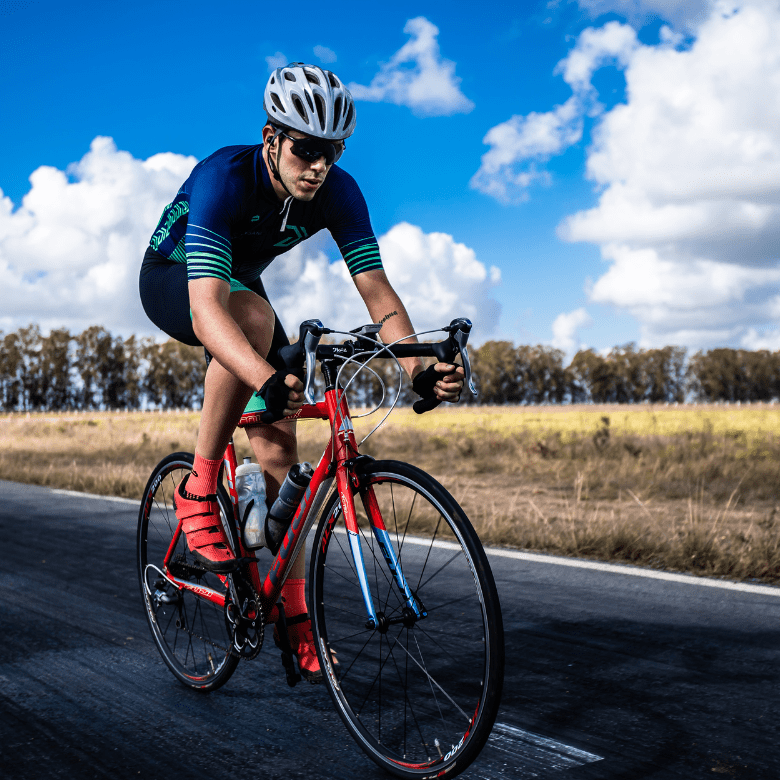
If you’ve ever researched bike helmets, you’ve likely seen the term MIPS (Multi-Directional Impact Protection System). But is it actually safer? Or just marketing hype?
To get a clear, science-based answer, we consulted a board-certified neurologist who studies brain injury. The clear takeaway is: the best helmet is the one you wear on every ride.
In our last deep dive into a neurologist’s input on bike helmet safety, we explained why head protection goes beyond bumps and scrapes. That same expert joins us again to explain how modern helmet technologies perform in testing, and what matters most when choosing one.
If your budget allows, technologies like MIPS and other modern designs can add an extra layer of protection against the kinds of forces most likely to cause brain injury.
In this article, we’ll break down these helmet technologies, explain what the research shows, and help you understand the details.
Our Expert Contributor
This article includes insights from a board-certified neurologist practicing at a top-3 global hospital (Newsweek 2025) and a top-20 U.S. hospital (U.S. News 2025–2026). He has reviewed published research on helmet-related injuries and has seen firsthand the neurological consequences of riding without proper protection.
We may earn a commission through our affiliate links at no extra cost to you.
Related
Convinced? Here are the best MIPS helmets to buy.
We’ve rounded up the 11 best MIPS helmets for cyclists and runners — vetted for protection, fit, and value so you don’t have to sort through the noise.
See the Full ListWhy Helmet Technology Has Evolved

Traditional bike helmets were designed primarily to protect against linear impacts — direct hits where the force travels straight through the helmet.
But real-world crashes are less predictable.
- Wheel slides on gravel = sideways fall
- A car door opens = rotational impact
- You crash when turning = angled strike to the temple
These create rotational forces, which cause the brain to twist inside the skull. This twisting can stretch axons and lead to diffuse axonal injury, a common mechanism behind concussions.
“Even small rotational forces can cause structural brain changes,” our neurologist explains. Reducing that rotation is one of the most meaningful improvements in modern helmet design.”
To address this, helmet makers have developed new designs that go beyond absorbing a single, direct blow.
What MIPS Actually Does
MIPS is a thin, low-friction slip layer inside the helmet. During an angled impact, it allows the head to move 10–15 mm independently of the helmet.
This helps reduce:
- Rotational velocity
- Rotational acceleration
- Twisting of the brain
Think of it like a tiny buffer that absorbs rotational energy before it reaches your brain.
Modern Helmet Technologies Explained

Not all helmets are built the same. While the basic job is to absorb a hit, newer designs add extra protection for real-world scenarios.
Cycling helmets now use various systems to address rotational forces:
- MIPS (Multi-directional Impact Protection System): A thin slip-layer inside the helmet that lets your head move slightly during a crash. This helps reduce the twisting forces that can cause brain injuries.
- WaveCel: A honeycomb-like liner that bends and crumples to absorb impact.
- SPIN (Shearing Pad Inside): Gel-like pads that allow a little movement between your head and helmet, similar to MIPS.
- LDL (Low Density Liner): Designed with softer, dual-density foam inserts intended to cushion rotational forces during angled impacts.
- Hövding 3.0: An airbag worn around the neck that inflates on impact, protecting the head like a giant cushion.
How Helmets Are Evaluated in Safety Testing
Researchers look at four major metrics:
- Linear acceleration: straight-on forces
- Rotational acceleration: how sharply the head twists
- Rotational velocity: how fast the twist happens
- BrIC (Brain Injury Criterion): calculated estimate of brain injury probability
These measures let researchers test how well these designs reduce brain injury risk.
How Well Do These Technologies Perform? (Study Data)
According to one study, MIPS and SPIN reduce harmful rotational forces more effectively than standard helmets.
Here’s a breakdown of how they perform in independent testing:
| Helmet Type | Rotational Velocity | Rotational Acceleration | BrIC Reductions | Concussion Risk |
| Standard | X | X | X | Baseline |
| MIPS | 26% ↓ | 22% ↓ | 24% ↓ | 42% ↓ |
| SPIN | 31% ↓ | 37% ↓ | 31% ↓ | 54% ↓ |
| LDL | X | 61% ↑ | X | Similar to Baseline* |
*LDL increased twisting forces in testing, but formal concussion risk scores came out similar to standard helmets because of how those scores are calculated.
As the data shows, not all helmets are created equal. Here’s why that matters when you’re shopping for a new lid.
Real-World Interpretation

Lab results don’t reflect every crash scenario. But overall:
✔ MIPS and SPIN consistently reduce rotational energy
✔ WaveCel can exceed both in specific angled impact tests
✔ LDL can underperform
✔ Fit, coverage, and shell design also matter
✔ A $60 MIPS helmet can protect as well as a $300 one
By far, the biggest takeaway is:
A helmet that fits well and includes a rotational protection system is almost always safer than one that doesn’t.
What This Means When Choosing a Helmet
Here’s what matters most:
1. Look for rotational protection
Systems like MIPS, SPIN, or WaveCel offer proven benefits.
2. Don’t assume expensive = safer
Higher prices typically reflect ventilation, weight, or premium materials, not protection.
3. Prioritize fit and comfort
The safest helmet is the one you’ll wear on every ride.
4. Choose the right coverage style
- MTB helmets: deeper coverage for side and rear impacts
- Road helmets: maximize ventilation
- Commuter helmets: often add lights + urban coverage
Bottom Line: Are MIPS Helmets Better?
In most common crash scenarios, MIPS helmets reduce rotational forces better than standard helmets.
They’re not perfect, and they don’t eliminate concussion risk entirely, but they address one of the most important injury mechanisms in cycling crashes.
If you want to choose a helmet backed by science, start with a MIPS helmet for smarter brain protection.
Medical Disclaimer
This article discusses general cycling helmet safety concepts and research findings for educational purposes only. It is not medical advice. Consult a healthcare professional for diagnosis or treatment of head injuries.
Steady Athlete Newsletter
Train smarter. Perform better.
Expert-backed training, nutrition, and recovery insights for athletes 35+. Designed for your busy life, not a 22-year-old’s schedule. Subscribers also get free exclusive guides like the Race Day Fuel Cheat Sheet for Masters Athletes.
Get the Newsletter