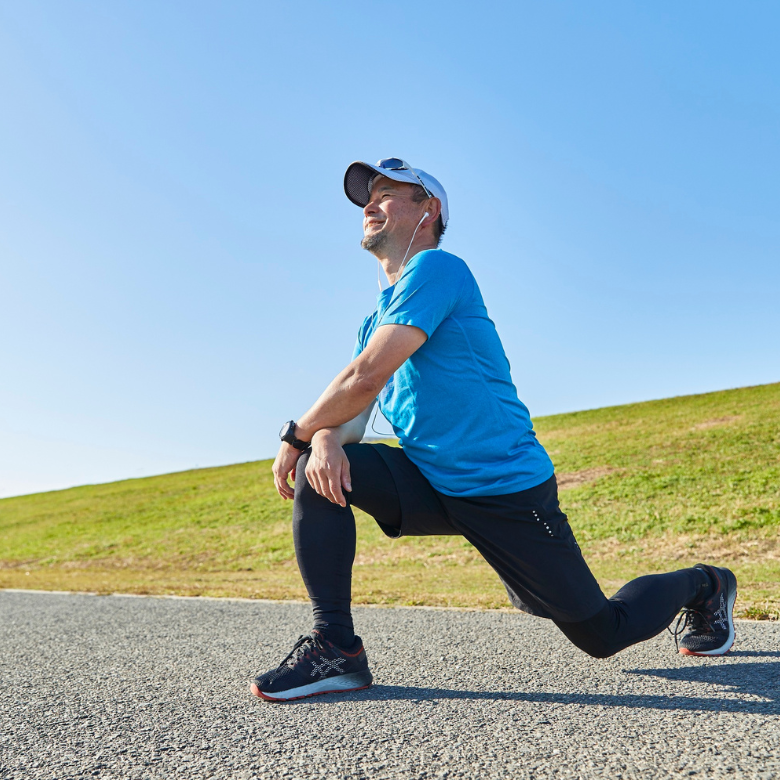
A Masters Athlete’s Guide to Better Mobility and Performance
Featuring Alia Bisat, CSCS
When Alia Bisat started teaching yoga, she couldn’t touch her toes. She knew the anatomy and understood the theory, but still couldn’t get there herself.
What she’s learned about stiffness along the way is probably surprisingly different from what you’ve been told.
Bisat, a Brooklyn-based movement coach with advanced training in pain science under researchers Lorimer Moseley and Greg Lehman, and stretch biomechanics instruction from Jules Mitchell, has spent nearly a decade helping older adults move and feel better.
Her story challenges common myths you might recognize. You have flexibility or you don’t; feeling tight means something is wrong; and stretching more is the obvious fix.
But the reality is different. If you’ve been stretching tight hamstrings or hip flexors for months with no progress, there’s a reason. Here’s what every masters athlete needs to know about the link between stiffness and aging.
We may earn a commission through our affiliate links at no extra cost to you.
Train Smarter Series
Read the Full Series
- Building a Strong Winter Base
- Smarter Winter Nutrition for Endurance Athletes
- Winter Strength Training for Durability and Power
- How to Reintroduce Intensity Without Undoing Your Winter Work
- Fuel Smarter: Race-Day Nutrition for Busy Masters Athletes
- Hydrate Smarter: What Masters Athletes Get Wrong About Water, Electrolytes, and Performance
- Move Smarter: Stiffness After 40 Isn’t Inevitable ← You are here
Why Warming Up Isn’t Optional Anymore
Most athletes understand the warmup basics. Raise your heart rate, improve blood flow, and do dynamic stretches so you don’t pull something. But there’s an important layer many athletes miss.
“Warm ups and cool downs are totally underrated as nervous system primers and regulators,” Bisat says. “Most people understand that a warm-up literally warms you up. It raises your body temperature and requires your blood to circulate faster. Faster blood circulation means your muscles are getting the oxygen they need to support what you want them to do.”
But most athletes aren’t aware that the nervous system is equally involved. “Our nervous system always wants to feel safe.” She adds that the nervous system doesn’t like surprises and feels more secure when it knows what’s coming.
She explains that warming up with movements that mimic exercises you’re about to do primes your nervous system for what’s next. “Your muscle tissues adjust their baseline tone, and there’s a physiological ‘readiness’ as your nervous system expects that you’re going to take your limbs into certain ranges of motion and contract your muscles to a certain intensity.”
That’s why the first mile of a run feels so different from mile three, especially if you’ve skipped or shortened the warmup.
According to Bisat, warm-up requirements also reflect your physical state more than your age. “Warm-ups become exponentially more important for those who move or hydrate less, less regularly get their heart rate up, or start a workout stressed out or frazzled.”
If you’re a masters athlete juggling a demanding job and a full schedule, you’re probably checking most of those boxes on any training day. Plan accordingly.
Busting The Tightness Myth

Like most masters athletes, you probably assume it’s time to stretch more when something feels tight.
The reality is more complex, Bisat explains. “The foundation for this concept is understanding that tightness is a feeling, not an actual mechanical property of your tissues.” She reminds athletes that “your muscle isn’t actually shorter when it feels tight or longer when it feels loose.”
For masters athletes, that means endlessly stretching a “tight” muscle isn’t always the answer. The feeling of tightness can come from several different places, and the solution depends on which one you’re dealing with.
Bisat breaks it down into four categories:
Motor Pattern Issues
Think of a chronically contracted muscle around the neck or shoulders that you can “stretch or strengthen all day with little change,” Bisat says. “Your body is maintaining a low-level contraction in a specific area, often because the brain isn’t receiving enough sensory information from that area or a related area, which affects how you hold yourself,” she explains. “Working with someone to figure out the underlying cause is key to unlocking the tension.”
“Unsafe” Tightness
Pushing past warning signs of pain or discomfort is another issue. “If you fold forward and can’t reach your fingers to the ground because your hamstrings are screaming, this is your nervous system telling you, ‘I do not want to stretch out that way, it doesn’t feel like a safe place to be.’”
Passive stretching, where you hold one position for a set time, can be effective if it’s done slowly, relaxed, and with steady breathing, says Bisat.
But an even more efficient approach is to load those long ranges instead of just stretching them. “Strengthening the hamstrings in Good Morning, Jefferson Curl, or Straight Leg Deadlift exercises helps communicate with your nervous system that these ranges are safe places to be,” Bisat explains. “This can be an excellent way to make lasting changes to your flexibility while also getting stronger in a range of motion you can now use.”
Hypermobility
Some people can put their legs behind their heads and still feel tight. That’s also a nervous system issue, sometimes connected to a collagen disorder, Bisat explains. “In this case, your brain craves more sensory information from your body.” For hypermobile athletes, she suggests starting with bodyweight isometric contractions and “lots of external sensory input with massage balls and foam rollers.”
Range of Motion Decline
Moving less over time causes a gradual range of motion decline. “As we get older, most people have more years of moving less, which means their ranges of motion in their joints and muscles get smaller and smaller, as best described by the adage, ‘Use it or lose it,’” Bisat says.
The fix? More movement.
“Active mobility work and strength training within one’s full range of motion is the easiest way to ease up on that feeling of tightness,” she explains. “Sensory receptors in your joints and muscles ‘wake up,’ your tissues stay better hydrated and reorganize their fibers for smoother movement, and you start to build muscle and rewire how your brain uses your body.”
Why Runners and Cyclists Are Always So Tight — And How to Fix It

Spending too much time on one movement pattern can cause certain muscles to become tight and overworked, leading to imbalances and even injuries. For runners, it’s usually the calves, hamstrings, and IT band. Cyclists most often use their quads, hip flexors, and lower back.
“When you stress only one position in your body over and over again, it’s going to get cranky if you’re not doing anything to offset it,” Bisat says.
Lack of movement, such as sitting, can also cause tightness and stiffness that impacts your training. “If you’re sitting for hours without taking your body into different ranges of motion and joint positions, things will start to complain.”
These patterns aren’t inevitable, Bisat explains. But quick fixes such as a few minutes of stretching before and after a run or ride aren’t enough.
“Most athletes will spend a couple of minutes stretching before and after their session, which is akin to getting up from your office chair to go to the bathroom and thinking that’s going to offset the past five hours you just spent sitting,” Bisat says.
Her soccer analogy helps illustrate this point. “Imagine your muscles were each a different soccer player on a team. Biking and running use a specific set of players on the field and leave the rest of the team benched,” Bisat explains. “The players on the field each have a vast number of skills but are asked only to use one of their skills, over and over again.”
The result is predictable. “They’re going to be overworked, tired of only performing that one skill and will start complaining to the coach.”
What fixes the tightness problem is introducing different movements. “Get your whole team engaged in a variety of skills,” she says, pointing to locomotive floor practices and varied mobility routines as particularly effective tools.
What to Do When Your Stretching Routine Stops Working
Has your body stopped responding to the stretch sequence you’ve been doing since your late 20s?
The culprit is a routine that’s stopped challenging you, Bisat explains.
“One of the foundational principles of physical adaptation is the Principle of Progressive Overload,” she says. “We only adapt when adequately challenged. If you’ve been doing the same routine for 20 years, your body has nothing to adapt to.”
Without that challenge, consequences can appear earlier than expected.
“Unfortunately, our bodies don’t stay the same over time,” Bisat notes. “Every week that we don’t challenge our bodies, we get weaker.” This compounds over time with predictable results, she explains. “We lose muscle mass and specific types of muscle fibers. Sensory receptors go quiet, collagen disorganizes, and bone density decreases.”
But this isn’t meant to alarm, Bisat adds. “I don’t like to fear-monger. It’s just a reality of how our bodies work from our 20s onward. Our bodies really hate to retain what’s not being used because it costs too much energy.”
The good news? The fix is straightforward.
“Your mobility routine — and strength and cardio routines — have to stay challenging just to maintain what you have,” Bisat explains. “If you want to go beyond just maintenance, the challenge and frequency will have to increase.”
Your 5-Minute Morning Sequence to Boost Flexibility

Bisat put together a quick morning sequence specifically for chronically tight athletes. You can do this before coffee or as a warm-up.
It includes five moves:
- Around the World
- Deep Squat
- 90/90
- Vaults
- Crab Reach
Subscribers get Alia’s full instructional video plus detailed exercise descriptions for free.
Meet Alia Bisat
A movement coach and Certified Strength and Conditioning Specialist (CSCS) based in Brooklyn, NY, Alia draws on advanced training in pain science. She helps older adults and people with pain move and feel better, with a philosophy grounded in the body’s infinite ability to adapt.
Have a question for Alia or want to connect?
| Website aliabisat.com | |
| Instagram @aliabisat · @themobmembership | |
| Email alia@aliabisat.com |
Steady Athlete Newsletter
Train smarter. Perform better.
Expert-backed training, nutrition, and recovery insights for athletes 35+. Designed for your busy life, not a 22-year-old’s schedule. Subscribers also get free exclusive guides like the Race Day Fuel Cheat Sheet for Masters Athletes.
Get the Newsletter