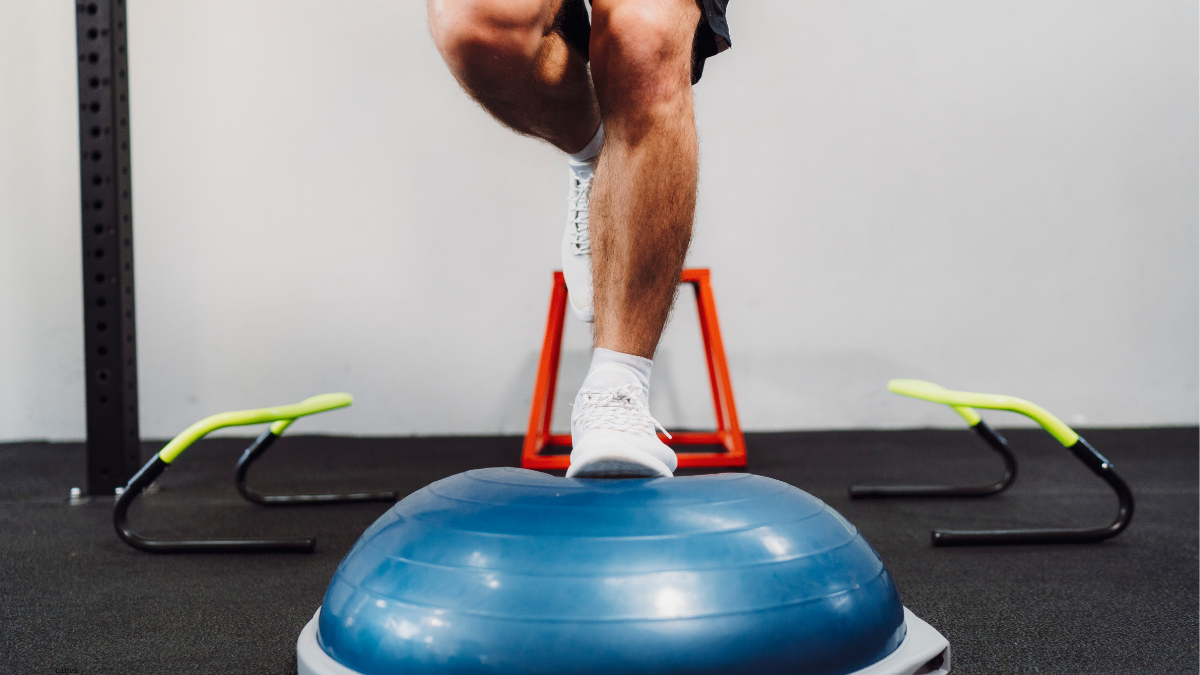
As athletes, we’re encouraged to track metrics such as pace, power, and heart rate. But when was the last time you tracked how long you can stand on one leg?
Age-related balance decline is well-documented. One Mayo Clinic study found that single-leg balance declines faster with age than grip strength, knee strength, or walking speed, dropping 17–21% per decade in adults over 50.
For runners, the benefits are tangible, as every stride is a single-leg landing. Since cycling happens on a stable platform, it doesn’t train single-leg stability. Balance training off the bike helps strengthen the hips and core to keep you steady in and out of the saddle.
In our small home gym, we use a multi-purpose padded balance mat. It’s a fun addition to a strength training session or for warming up before a Peloton class or a run. This list covers different types of boards, from beginner-friendly to advanced, to help boost your balance and stability.
We may earn a commission through our affiliate links at no extra cost to you.
The Original Indo Board ($199.00)

Although it was originally developed for surf training, the Indo Board offers many benefits for masters athletes. It engages the whole body to help improve your posture, strengthen your core, and sharpen reflexes.
Whether you’re into running, cycling, snow sports, skating, or a different activity, it’s a versatile tool you can use for strengthening and injury prevention. Plus, it’s a fun alternative to a normal workout.
Ideal for all ages and activity levels, the board comes with a roller to challenge your balance and coordination. You can use it for basic balancing as well as push-ups, dips, and core work.
If your balance is poor when you start, the size of the board and the roller can make it especially challenging. Some athletes prefer to start next to a couch, wall, or solid surface until they get the hang of it.
Revbalance 101 v2 – Balance Board Sports Trainer ($169.95)

A more beginner-friendly alternative to the Indo Board, the Revbalance 101 v2 lets you choose between three difficulty settings. You can adjust it to beginner, intermediate, or advanced levels, which alters the rolling distance accordingly.
If the thought of toppling over when you first start makes you hesitate, you can progress at your own pace with this board. Plus, the surface has plenty of grip and isn’t as hard on the floors or bare feet.
New to balance boards, or worried you’ll get bored once you improve? An included digital guide covers beginners through advanced users, so you can start at a comfortable level and work your way up once you get better.
However, the surface is smaller than some other boards. That can make it a little harder to maintain equilibrium, especially for beginners.
STAASH Balance Board Full Kit ($164.99)

If you live in an apartment or small house and worry about disturbing others, the STAASH board is built for noise reduction. It comes with a cork mat and roll to dampen any sounds. Plus, the anti-slip surface is suitable for indoor and outdoor use.
For balance training, the 31×15-inch surface offers enough room for beginners to feel comfortable. Intermediate to advanced users also have ample practice space.
Besides improving general balance, it strengthens the muscles that stabilize your knees, hips, and ankles, and can be used for rehab after an injury. Use it in tandem with yoga or strength sessions, or as a standalone workout.
You’ll find a balance disc for beginners, a roller for intermediate levels, and a massage ball for advanced users. Each component in this kit is made with 100% recycled materials. However, some users say the cork mat is a little thin and can wear down over time.
XCMAN Surf Balance Board Trainer ($95.80)

Improve your agility, balance, and core strength with this wooden trainer. Built for maximum durability, it’s made with heavy-duty wood and holds up to 350 pounds. It’s also relatively light, at 6.6 pounds, so you can take it on the go.
Ideal for general balance training and specific activities such as yoga, golf, baseball, and snowboarding, the non-slip surface keeps feet from sliding as you practice your moves. You can use the trainer on various surfaces, from carpets to hardwood to concrete.
This wooden training board is also water-resistant and can be used inside or outdoors by novice and experienced athletes. Some users wish the surface size was slightly larger.
Blue Planet Balance Surfer ($179.88)

Most balance boards have one training mode, which can make it challenging for beginners and too easy once you’ve mastered your skills. The Blue Planet Balance Surfer has three distinct foam training modules, so you can progress after you’ve mastered the basics. Each module has two curvature directions for multiple difficulty options.
A non-slip grip keeps feet firmly in place, while the 25-inch wide curved deck offers ample space to practice. Some boards are wider, which can help beginners, but there’s still room for a wide, steady stance.
Besides general balance, you can use the surfer to practice sport-specific balance for activities such as standup paddleboarding, snowboarding, and other activities that benefit from good balance skills.
The Skill Board – Wooden Balance Board ($158.00)

Crunched for time but still want to do something active? The Skill Board can be used at a standing desk or in a home gym. You can improve balance, agility, and reaction times while strengthening your core. It’s an ideal way to improve your everyday balance and benefit from sport-specific training for running, skiing, wakeboarding, and other activities.
New to balance training? You can adjust the air pressure inside the inflatable exercise ball. Less air makes it easier and more air increases the difficulty level. Some boards include multiple balance tools for a wider range of skill progression, but this one just comes with a standard ball.
BOSU Pro Balance Half-Ball Trainer ($159.99)

A staple in many home and commercial gyms, this BOSU ball lets you focus on building stability and strength. Unlike wooden balance trainers, which are highly specialized for balance, this BOSU dome is more versatile for bodyweight exercises.
Featuring a dome on one side and a flat surface on the other, it’s ideal for squats, lunges, planks, and weighted exercises. The air bladder is naturally unstable as it’s compressed, which forces micro-adjustments as you adapt. Over time, this strengthens and engages more muscles.
The same air dome that can enhance workouts and help build muscle can also be less reliable than a hard roller or ball that comes with a wooden trainer. Plus, you need to keep it properly inflated to get the maximum benefits.
Amazon Basics Wood Balance Trainer Board ($18.75)

Here’s another option for full-body workouts. This wobble board can help improve your balance, posture, coordination, and strength. Use it for exercises such as planks, push-ups, and standing balance poses. It’s also useful for strengthening specific joints, muscles, tendons, and ligaments.
The “standing side” is a solid wood surface that supports up to 265 pounds. Besides home workouts, it’s ideal for general balance training and sports rehab.
However, it should only be used on dry surfaces. Wet or smooth surfaces can make it too slippery to use safely.
Sportneer Balance Board ($85.49)

Another multi-mode balance trainer, this board includes a roller and ball to enhance your workouts. It isolates and works the ankles, which can help athletes of all ages and levels prevent injuries and improve performance.
Besides a durable roller, it includes a solid rubber ball so you can increase or decrease the difficulty. As you progress, you work up to learning to balance on the smaller, less stable surface.
If you’re new to balance training, you can build a strong foundation by mastering basic balance and stability, then work towards improving balance and lower-body control for a better athletic stance. From yoga to running to water sports, having a strong foundation is key to performing better.
Made with thick birch wood, this balance trainer supports up to 450 pounds. Use it to warm up, cool down, or enhance a weightlifting routine.
Although this board is highly adjustable, the half-circle safety rails aren’t the easiest to assemble. Some users struggle to insert them.
StrongTek Wooden Balance Board ($38.99)

If you want more challenge than a basic balance board, this one adds 360° directional wobble to train ankle control, stability, and coordination. Unlike basic balance boards, which move back and forth or side to side, this one works your balance in every direction.
Despite the increased challenge, this board is also very stable. At the center is a cross-style base with a larger floor contact area for more control. It’s easier for beginners than round-base challenge boards, yet more difficult than basic rocker boards, so you can build confidence and skills.
However, difficulty levels aren’t adjustable. More advanced users may find it limited once their skills improve.
EVERYMILE Wobble Exercise Balance Board ($44.99)

Improve your balance with this wobble balance board, which has 360° rotation and a 15° tilt. Use it to strengthen ankles or to add instability for strength moves such as core exercises and squats. You can use it for targeted strengthening or full-body drills.
Ideal for everything from side-to-side movements to circular drills and stretching, this versatile balance board is also highly portable. Integrated handles make it easier to transport, and it weighs just 3.5 pounds.
Measuring 15.7 inches in diameter, the stance might feel a bit narrow for some users. Plus, the integrated handles take up some of that valuable foot space.
SlackBlock Athletic Balance Trainer ($63.00)

If a full-sized balance trainer takes up too much space, consider this compact alternative. Available in sizes from 13 to 15 inches, the SlackBlock supports over 230 pounds. It’s lightweight and easy to pack, so you can bring it to the gym or a hotel if you’re traveling.
You can work towards better balance with this trainer, which helps build agility, coordination, and speed. Whether you’re into running, cycling, hiking, ball sports, or general fitness, improving your balance can help you perform better.
Unlike most balance trainers on this list, this one doesn’t come with a larger surface to help you get started. Beginners might find it more challenging to use this balance trainer. Consider standing against a wall or a firm surface until you’re more comfortable balancing without support.
ProsourceFit Exercise Balance Pad ($26.99)

If you’re intimidated by the thought of learning to balance on a traditional trainer, this pad is a great alternative. It’s lower to the ground and has a spacious surface, so you can comfortably build confidence and balance skills.
Since the surface is larger than most balance trainers, the challenge comes from learning to balance on foam. That’s because foam naturally creates an unstable surface. As you work on your balance, you’re boosting core strength as well as foot and ankle stability. It’s useful for practicing lunges, squats, planks, and crunches.
Unlike traditional balance trainers, this balance pad can be used outside of your workouts. It doubles as a cushioned pad for gardening as well as for a seat cushion or to keep feet comfortable at a standing desk.
Although this balance pad is beginner-friendly, you might outgrow it as your balance and coordination improve.
Terra Core Balance Trainer ($249.99)

Despite its name, this balance trainer can be used for more than core workouts. It’s ideal for crunches, planks, squats, lunges, and other full-body conditioning exercises. Terra Core says the dome’s instability helps engage up to four times more muscle groups than the same exercises performed on a flat surface.
One side has a dome that creates instability for balance work and core engagement. Flip it over for push-up handles that cater to agility drills, upper body strength, and dynamic exercises. You can use this platform with static or adjustable dumbbells, heavy-duty resistance bands, kettlebells, suspension trainers, and full-body exercises.
Looking for more guidance? Scan the QR code to access the Terra Core guided training sessions on YouTube.
One potential concern is that the dome can lose air and deflate over time, especially with frequent use. You may need to add more air before workouts to get the full benefit.
SIDEKICK AxisBoard Balance Board for Foot & Ankle Rehab ($89.00)

It’s easy to overlook the feet and ankles when focusing on building strength. But they’re essential for good balance. The AxisBoard helps activate the stabilizing muscles in your feet and ankles to boost your balance and stability.
Whether you’re an athlete looking to get stronger or you’re focused on healthy aging, the board can be used for general strength and stabilization along with dorsiflexion and lower leg strength.
Featuring a non-slip surface, the board keeps feet stable as you practice and grow your skills. As you progress, you can unlock over 900 height configurations using the stackable pegs to level up your skills. An app training program with visuals helps guide you through workouts.
Since this balance board is designed for the feet and ankles, it lacks a larger surface area for full-body workouts.
FAQ
Which muscles does a balance board work?
Balance boards work the small stabilizer muscles, especially in your feet and lower legs. That includes the peroneals along the outside of your lower leg, as well as the tibialis muscles and calves. The small muscles in your feet get worked too, especially if you train barefoot. Balance boards work these muscles for control and stability. Pair them with single-leg strength work to help correct imbalances.
Are balance boards worth it for runners and cyclists?
For runners, yes. Running is a single-leg sport, and better hip and ankle stability helps your body absorb that load, especially as fatigue builds in a long run or race. For cyclists, riding on a stable platform doesn’t train single-leg stability, so the hip and core stabilizers that keep your pelvis steady are often undertrained. You feel it most out of the saddle, late in long rides, and in non-pedaling movements, like unclipping at a light.
Does balance get worse after 40?
Yes. One study of 105 healthy adults found that the inner ear’s ability to sense motion remains steady until around age 40, then declines every decade after. Those with weaker motion detection were more likely to fail a standard balance test, and poorer balance is linked to a higher risk of falling. Fortunately, balance is trainable at any age. A balance board or trainer is an effective way to improve.
How can I test my balance at home?
Stand on one leg and time how long you can hold it without touching down or losing your balance. Then switch legs. Expect your non-dominant leg to be weaker. Retest after using a balance board for a few weeks to monitor your progress.
Steady Athlete Newsletter
Train smarter. Perform better.
Expert-backed training, nutrition, and recovery insights for athletes 35+. Designed for your busy life, not a 22-year-old’s schedule. Subscribers also get free exclusive guides like the Race Day Fuel Cheat Sheet for Masters Athletes.
Get the Newsletter